
Insights
Ideas worth
returning to.
Writing on operational leadership, safety culture, decision-making, and building organizations that perform under pressure. Real experience. No theory.
Writing on operational leadership, safety culture, decision-making, and building organizations that perform under pressure. Real experience. No theory.
Each piece starts with a real situation, a real team, or a real decision. That's the only kind of insight worth sharing.
Everything I write fits inside one of these four areas — the through-line across every post below.
Growth without capability creates fragility. The best organizations benchmark against the best, not last year.
Compliance gets you the baseline. Capability gets you through the crisis.
A software license is not a strategy. The tool works for us — we don't work for the tool.
The value lives at the intersection — where production, maintenance, and quality data meet.
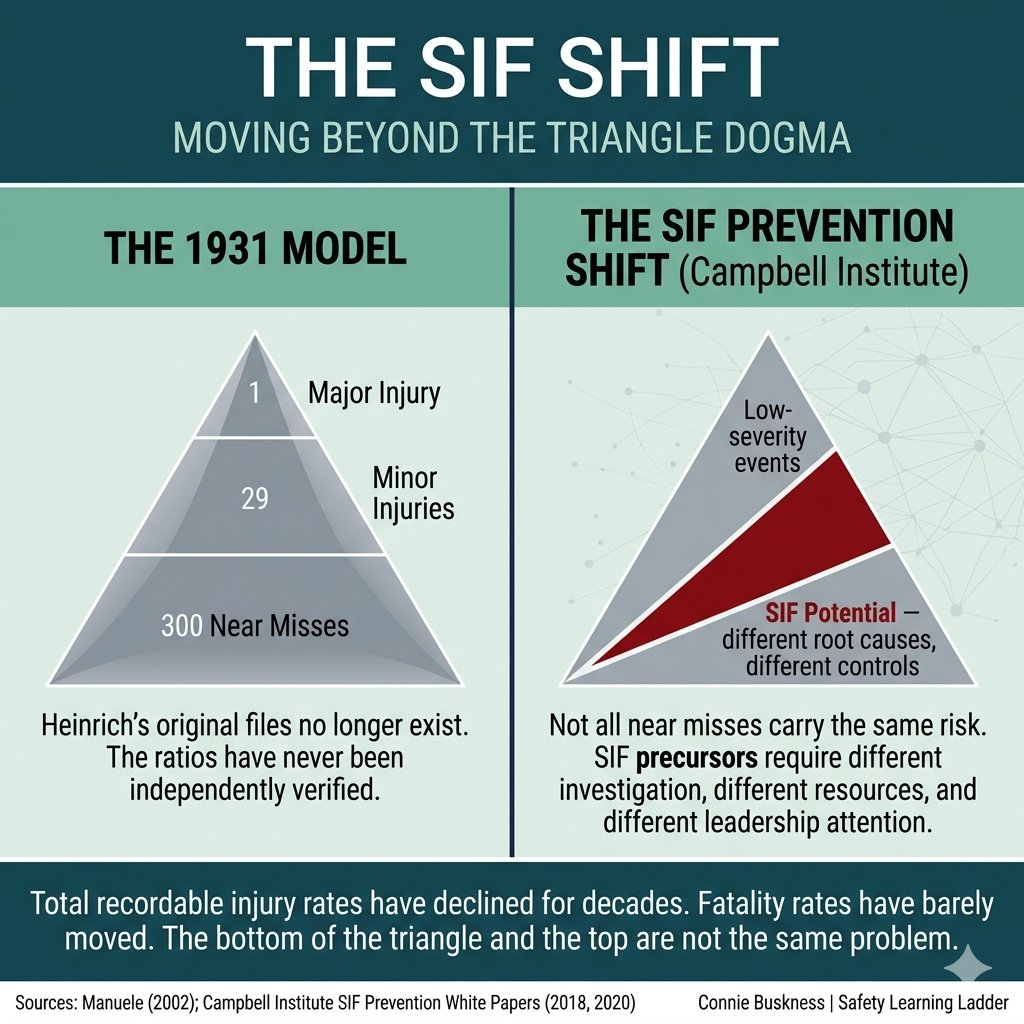
We've spent decades chasing minor injuries to prevent fatalities. The data has been telling us otherwise for years — recordable rates keep falling while fatality rates barely move. The Campbell Institute documented why: serious-injury precursors don't share the same root causes as low-severity events. After deploying AI across 50,000+ safety records, the signal was clear — it was always there, buried under decades of noise.
41K impressions · 68 comments · 35 reposts
Read on LinkedIn →I went for the memories with my daughters. I stayed for the operational discipline. Hire the best, empower individuality, then engineer the execution down to the split second — because when precision fails, it's not just the performance that suffers.
Read on LinkedIn →For 18 years we gave our girls structure. Then they left for college and the checklist stayed home — what went with them was judgment. I see it in operations every day: at 2 AM, the binder isn't making the decision. Your people are.
Read on LinkedIn →I learned it on night shift in a Unipol polypropylene plant in Seadrift, Texas — where standards were sacred and nobody had to tell you why. Everything since has been building on that foundation, with better tools. (Unipol alumni around the world wrote in.)
Read on LinkedIn →My daughter walked into a few houses during rush and knew within minutes: not her people, not her place. I've had the exact same feeling walking into an interview. Structure creates the space to succeed. Culture determines whether people stay.
Read on LinkedIn →I've watched companies triple in size and become less safe — not because they stopped caring, but because they assumed safety would scale automatically. Growth without capability creates fragility. The time spent building the foundation isn't a delay. It's an exponential return.
Read on LinkedIn →"It's never happened here before." Said with confidence — usually right before something goes wrong. In high-hazard operations, absence of failure is not proof of safety. Sometimes it's just proof of luck. Are we listening to the signals, or comfortable being lucky?
Read on LinkedIn →Early in my career, Phillip Townsend data humbled me — we thought we were performing well. We weren't. That reshaped how I think about performance. That's why organizations like ACC, AFPM, and CCPS matter: they create environments where truth shows up.
Read on LinkedIn →Most financial conversations about safety focus on what's easy to quantify — fines, comp, regulatory exposure. But those are just the invoice. Lost production on a sold-out plant, downtime rippling through the supply chain, leadership pulled from growth into recovery. As Trevor Kletz said: if you think safety is expensive, try an accident.
Read on LinkedIn →AI doesn't create value inside a silo. It creates value at the intersection — where production, maintenance, and quality data meet and someone asks a question none of those teams could answer alone. The easy answer is a new tool. The real work is changing the culture that built the silo.
Read on LinkedIn →We're over-tooling and under-training. A tool is just a container — it collects information; it doesn't understand risk. Complete an MOC without understanding what the change does to the process, and you haven't reduced risk. You've digitized a bad decision. The tool works for us. We don't work for the tool.
Read on LinkedIn →Four days in a hackathon with AI programmers, engineers, and EHS leaders. By day four we had a clear picture of what was possible — not because the AI was magic, but because people who understood the operation sat next to people who understood the data and asked "what if?" McKinsey: 88% use AI; only 6% capture real value. That gap lives in the workforce, not the technology.
Read on LinkedIn →When Paul O'Neill became CEO of Alcoa in 1987, investors expected talk of margins. Instead he said: "I want to talk about worker safety." Some left to sell their stock. He understood what many still miss — safety and environmental performance are the clearest proxies for operational excellence. It's all the same system. By the time he retired, Alcoa's value had grown by billions.
Read on LinkedIn →Several of these posts are becoming full articles — the SIF shift, capability over compliance, the Alcoa lesson, and where operational excellence is really learned. I share the thinking as it develops.
Follow along on LinkedIn →